Exporting to the Eurasian Economic Union (EAEU): Understanding EAC Certification Requirements
Expanding your business into new markets can open incredible opportunities — and the Eurasian Economic Union (EAEU) is one of them.
Consisting of Russia, Kazakhstan, Belarus, Armenia, and Kyrgyzstan, the EAEU offers access to a vast consumer market and growing trade potential.
However, entering this market requires compliance with specific technical and safety regulations — the most crucial being the EAC Certification.
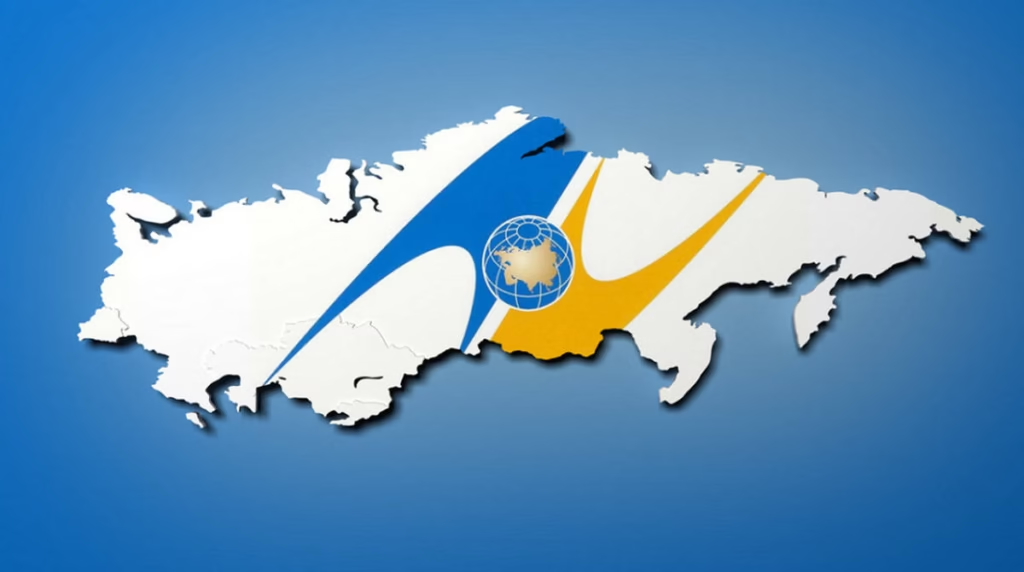
What Is the EAC Certification?
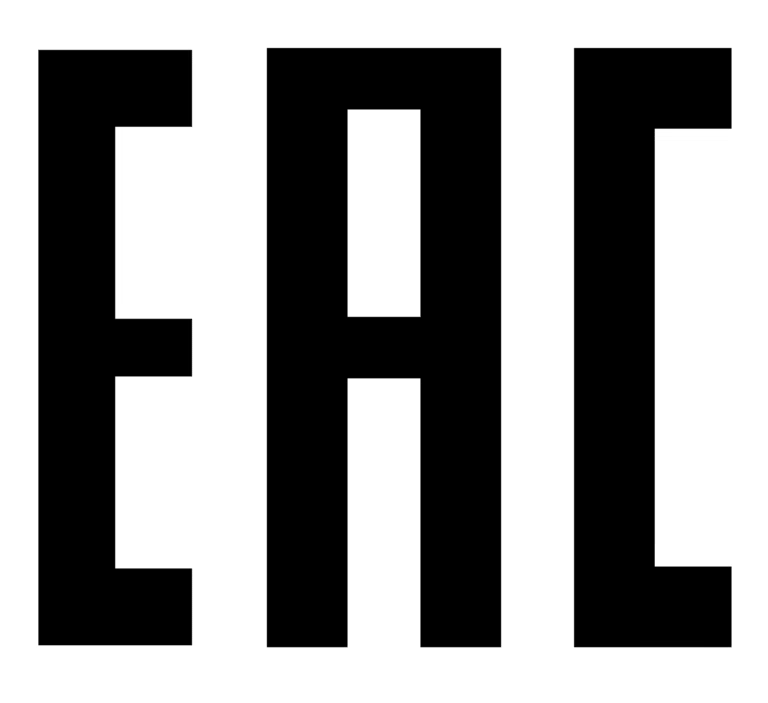
The EAC (Eurasian Conformity) certification is an official confirmation that a product meets the mandatory safety and quality requirements defined by the EAEU.
It serves a similar purpose to the CE mark in the European Union — ensuring that a product is safe, compliant, and fit for distribution across all member states.
Products that fall under EAEU technical regulations (TR CU or TR EAEU) must obtain this certification before entering the market. Without an EAC certificate or declaration, customs authorities will not allow the product to be sold or distributed within the EAEU.
Why EAC Certification Matters for Exporters
For European manufacturers and exporters, obtaining an EAC certificate is more than a legal necessity — it is a strategic business advantage.
The certification not only ensures compliance but also builds consumer trust and simplifies logistics within the EAEU region.
Key Benefits of EAC Certification
Market Access: Grants legal permission to import and sell products in all EAEU countries.
Unified Approval: One certificate is valid across all five member states — no need for separate national documents.
Consumer Confidence: Demonstrates reliability, safety, and product quality to local markets.
Trade Efficiency: Simplifies customs clearance and reduces delays at borders.
- Brand Credibility: Reinforces your company’s reputation as a responsible and compliant exporter.
The EAC Certification Process Explained
Step 1 – Identify Relevant Technical Regulations
Each product group — from machinery and electronics to cosmetics and food — falls under specific Technical Regulations of the Customs Union (TR CU).
These define the required safety, quality, and labeling standards.
Step 2 – Product Testing and Inspection
Samples must be tested in an accredited EAEU laboratory to verify compliance with technical and safety standards.
Testing ensures that the product meets all applicable parameters before certification.
Step 3 – Documentation and Registration
Manufacturers prepare a technical file, product description, user manual (in Russian), and quality management documents.
Once verified, the EAC certificate or declaration is officially registered in the EAEU database.
Step 4 – Labeling and Market Access
After certification, all approved products must bear the EAC mark on packaging, labels, and accompanying documentation.
Only then can the product be distributed or sold across EAEU territories.
Common Challenges and How to Overcome Them
The EAC certification process can be challenging, especially for first-time exporters unfamiliar with regional standards.
The most frequent obstacles include:
Complex regulatory structure: Multiple overlapping technical regulations.
Language barriers: Documentation and labeling must often be translated into Russian.
Testing differences: EAEU laboratories may use distinct methods from EU standards.
Renewal requirements: Certificates must be periodically updated to maintain validity.
The key to overcoming these challenges is working with an experienced export partner who understands both EU and EAEU requirements.
TM GmbH — Your Trusted Partner for EAEU Export and Certification
At TM GmbH, we specialize in helping European companies expand successfully into the Eurasian Economic Union.
Our team supports every step of the process — from identifying applicable regulations and organizing product testing, to managing certification and logistics.
We ensure that your exports are fully compliant with EAC and EAEU regulations, allowing you to focus on growing your business while we handle the technical details.

Conclusion: A Gateway to New Opportunities
The Eurasian Economic Union represents a fast-growing market with significant potential for European exporters.
Achieving EAC certification ensures smooth market entry, customer trust, and a competitive edge in the region.
With professional guidance and efficient processes, exporting to the EAEU doesn’t have to be complicated — and TM GmbH is here to make that journey seamless.

+49 5651 3312538
info@tmgmbh-online.de
Gebrüderstraße 15 D 37269 Eschwege
Copyright © 2025 All rights reserved
TM GmbH is proudly powered by WordPress